 ....
.... ....
.... .....
.....
org20 Dyes, dyeing, separation of black felt-tip pen ink
.............
What
you need: Black felt-tip pen STABILO point 88 fine 0.4,
plastic strip coated with silicagel, 5-ml injection bottle with a wide
mouth, dropper bottle with methylated spirit.
* Left: Cut a pastic
strip that fits to the mouth of the bottle. Make two dots on the
silicagel with the pen: side by side and 5 mm above the lower end of the
strip.
* Photo 2: Transfer
10 drops of methylated spirit into the bottle. Carefully place the strip
into the liquid.
Observations
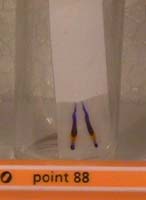
Photo 2, 3: The blue colour is separated into yellow, violet and
blue dyes by the ascending spirit.
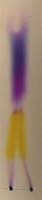
* Right: The
strip was dried. The silicagel with the yellow, violet and blue colours
can be removed separately.
Explanations
The black colour of the pen was attracted by the silicagel. The spirit
was lifted upwards through the silicagel by capillary forces (similar to
ink in a blotting paper). The black colour proved to be a mixture of three
different dyes. Each of them is bonded by the silicagel with in a
specific force and each of them is dissolved differently by the spirit
while it moves upwards through the silicagel.
So the three dyes moved
upwards with different speeds resulting in their separation.